Short answer
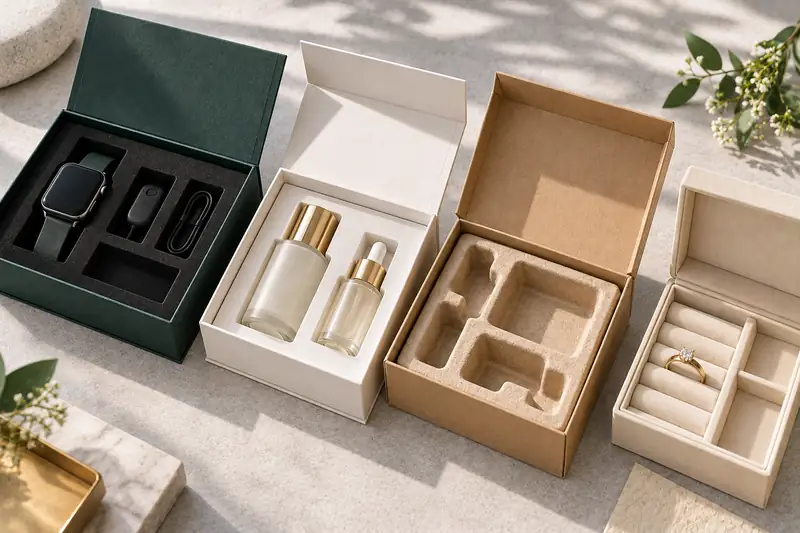
Use EVA for heavy or premium items that need a crisp cut-out, foam for cheaper cushioning, folded card for recyclable presentation, blister trays for multi-item sets, and satin or velvet lining when the reveal matters more than protection.
What an insert has to do
An insert holds the product still, protects it in transit and frames it when the lid opens. The right material depends on product weight, fragility, how many items share the box and whether the box must be fully recyclable.
Insert materials compared
| Insert | Protection | Look | Recyclable | Good for |
|---|---|---|---|---|
| EVA | High | Clean, precise cut-outs; can be flocked | No | Electronics, watches, glass bottles |
| PE / sponge foam | Medium | Soft; often covered with velvet or satin | No | Jewellery, gift sets |
| Folded card | Medium | Printed, matching the box | Yes | Cosmetics, candles, eco programmes |
| Paper pulp | Medium–high | Natural, textured | Yes | Tech accessories, sustainable brands |
| Blister / PET tray | Medium | Clear, shows every item | Limited | Multi-item sets, advent minis |
| Satin / velvet lining | Low | Luxurious reveal | No | Wine, fragrance, jewellery |
Getting the fit right
For die-cut inserts, send the actual product or a 3D file. A fit that is 0.5 mm too tight makes products hard to remove; 2 mm too loose and they rattle. We cut the insert on the sample and adjust before mass production.
Finger slots and ribbons
Deep cut-outs need a way to lift the product: a half-moon finger slot, a ribbon under the item, or a pull tab. Specify it early — it affects the cut.
By category
- Magnetic boxes for cosmetics: card or EVA with flocking.
- Drawer boxes for jewellery: velvet-covered foam.
- LCD video boxes: EVA around the screen electronics.
- Wine boxes: satin-lined cradle or card neck lock.