Short answer
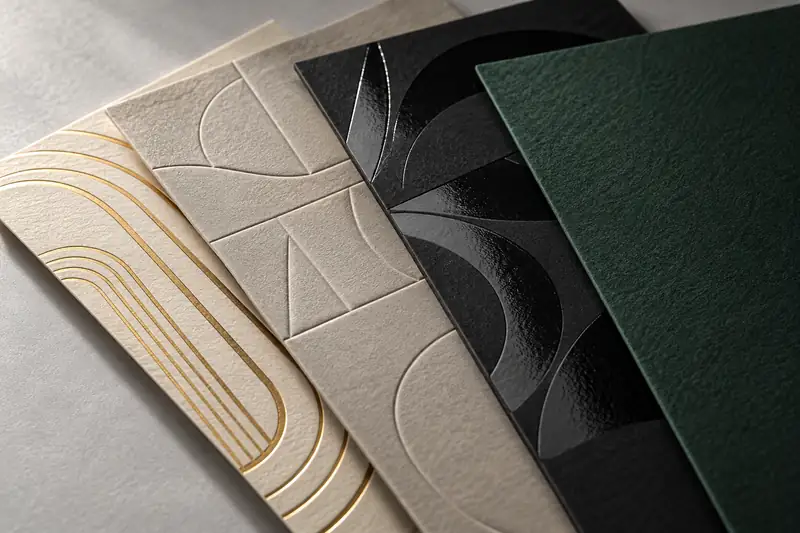
Hot foil adds metallic colour, embossing and debossing add relief, spot UV adds a glossy accent on a matte surface, and lamination protects the print. Two finishes is the sweet spot for most boxes — for example matte lamination with gold foil, or soft-touch with blind deboss.
Why finishes matter
Finishes are where a box stops looking printed and starts looking made. They also add cost per tool and per pass, so it pays to know what each one does before you specify five of them.
Lamination: the base layer
Lamination is a thin film bonded over the printed paper. It protects the print from scuffs and moisture and sets the base texture.
- Matte lamination — calm, low glare, the most common premium base.
- Gloss lamination — saturated colour, reflective, shows fingerprints less on dark colours.
- Soft-touch lamination — velvety feel; scratches more easily but feels luxurious.
For a plastic-free box, replace film lamination with an aqueous or water-based varnish.
Hot foil stamping
A heated metal die presses a metallic foil onto the paper. Gold and silver are standard; rose gold, copper, holographic and coloured foils are available. Foil works best on solid shapes and lines thicker than about 0.3 mm. Very fine text can fill in.
Embossing and debossing
Embossing raises an area of the paper; debossing presses it down. Both use a matched pair of dies. Blind embossing has no ink or foil — just relief — and is one of the quietest, most expensive-looking finishes. Combining foil with emboss on the same area (registered foil emboss) needs tight tolerances, so we always sample it first.
Spot UV
Spot UV applies a clear, glossy coating only where you want it, usually over a matte base. The contrast between matte and gloss makes a logo or pattern appear when the box catches the light. Raised (3D) UV adds thickness you can feel.
Finish combinations that work
| Base | Accent | Effect |
|---|---|---|
| Matte lamination | Gold hot foil | Classic premium; skincare, fragrance, gifts |
| Soft-touch | Blind deboss | Minimal, tactile; jewellery, tech |
| Matte black | Spot UV pattern | Hidden detail; spirits, electronics |
| Textured paper | Foil + emboss | Crafted, luxury; advent calendars, limited editions |
How finishes affect lead time
Each foil colour and each emboss area needs its own die, made in a few days. Within our usual 5–7 day sampling window this is already included, but last-minute finish changes after sampling can add days to production.
Artwork tips
- Put each finish on its own spot layer, named clearly (FOIL_GOLD, EMBOSS, SPOT_UV).
- Keep foil and emboss areas at least 2 mm away from folds and box edges.
- Send vector files (AI, PDF, EPS) — raster images cannot be turned into dies.